
Why visibility in Women’s Cycling Matters

Most people who hear the words Tour de France think of the iconic yellow jersey and male stars such as Tadej Pogačar and Jonas Vingegaard, rather than female stars like Demi Vollering, Katarzyna Niewiadoma or Pauline Ferrand-Prévot.
This difference in recognition raises important questions about equality and representation within cycling, and how differences in visibility and media exposure can influence girls and young women on the other side of the screen.
These questions inspired my final high school project, in which I explored the differences in visibility and media exposure between men's and women's cycling, with a particular focus on the Tour de France and the Tour de France Femmes, and what these differences can mean for young women and girls.
The short answer:
The visibility gap between men's and women's cycling is not just a matter of entertainment value, but it is shaped by historical differences, culture, public interest, media coverage and investment. These factors are closely connected, meaning that differences in visibility can reinforce existing differences in interest, media attention and investment.
This gap matters because it can affects the people watching. When girls and young women see women's cycling, they can see people they identify with competing at the highest level. My survey suggests that this can create feelings of inspiration, confidence and belonging, and make it easier for girls and young women to imagine themselves in the sport and as potential professional cyclists. Meanwhile women's cycling being associated with less prestige can create feelings of unfairness, demotivation and frustration amongst girls and young women.
The Tour de France Femmes has an important role to play in changing this. By giving female cyclists a bigger platform, it can help make female role models more visible and give more girls and young women the chance to see themselves in the sport. But one race cannot close the visibility gap on its own. The future of women's cycling also depends on broadcasters, media, sponsors, investment and, ultimately, whether more people choose to watch.
Want to know more?
(Press a line above to skip to that section)
Quick note: Since this research was conducted as part of my final high school project, it naturally has some limitations. If you are interested in learning more about the methodology and potential sources of error, you can read more here |
The visibility gap:
The visibility gap between the Tour de France and the Tour de France Femmes is not simply a question of the quality of racing or entertainment value. Instead, it is the result of several factors that have reinforced each other over time.
Why is there a visibility gap?
It starts with history

The Tour de France and Tour de France Femmes share the same iconic name, but they do not start from the same place. The men's race has been on the calendar almost continuously since 1903 and has had television coverage since 1948, with every stage being broadcast in full since 2017.
During its more than 120 years of history, the Tour de France have become more than a bike race. The yellow jersey, legendary climbs, famous champions, and long-standing traditions have turned it into one of the world's most recognizable sporting events.
Meanwhile, the modern Tour de France Femmes avec Zwift was only launched in 2022.
The race has benefited enormously from being connected to the Tour de France brand, which has helped it quickly become the biggest event in women's cycling. However, it is still building its own history, traditions, and identity, and it has not yet had the same opportunity to establish the same level of recognition and prestige.
This difference in history has given the two races very different starting points when it comes to building global recognition, media attention, and a dedicated fanbase.
However, history is only part of the explanation. Men's sports generally attract greater public interest than women's sports, including cycling. This is also shaped by historical factors, cultural norms, and decades of differences in exposure and investment.
Greater public interest also makes men's cycling more attractive for broadcasters, media outlets, and sponsors, further increasing its visibility.
Visibility creates visibility

Another important difference is the amount of coverage surrounding the two races. The men's Tour consists of 21 stages with full coverage accumulating to around 110 hours of live coverage, while the women's race consists of 9 stages with only a few covered in full accumulating to about 25 hours of live coverage in 2025.
This difference does not only affect how visible male and female riders are. Media coverage can also influences how important and prestigious a race is perceived to be. When one race receives full coverage and another does not, it can create the impression that one event is more important than the other.
At the same time, more coverage creates more opportunities to reach new fans and makes casual viewers more invested in the sport. This creates a cycle where more exposure leads to more interest, which can attract more media attention and investment, further increasing exposure.
Exposure is not only created by the organizers themselves. It is also shaped by news media, television studios, documentaries, social media, and the content created by fans, teams, riders, and sponsors. Here, the men's Tour also has a clear advantage, receiving more pre- and post-race analysis (at least in Denmark), more news coverage, and even its own Netflix documentary. All of this contributes to greater visibility.
Making the race easier to follow
Visibility is not only about how much coverage a race receives, but also how easy that coverage is to access. Although both races are broadcast in around 190 countries, the Tour de France Femmes is available on only around a quarter of the number of television channels as the Tour de France. In addition, the men's race is available on more free-to-air channels across Europe, making it easier for fans to watch.
Accessibility also extends beyond live broadcasts. The men's Tour de France benefits from additional international events, such as post-Tour criterium races in Singapore and Saitama, which help bring the race to new audiences. Likewise, the official Tour de France website and digital platforms are available in more languages than the Tour de France Femmes', making it easier for international fans to engage with the race.
Why do these differences matter?

The differences in visibility are not just about television hours or media coverage. They are also about what happens on the other side of the screen. The coverage and visibility of women's cycling can influence how girls and young women see themselves in the sport, and whether they can imagine a future within cycling.
To explore how these differences influence people in practice, I conducted a survey with 112 male and 112 female respondents.
(You can read more about the methodology and limitations here)
"If you don't see it, it's hard to believe it's possible."
One of the main findings of my project was an indication that limited exposure to women's cycling may make it more difficult for girls and young women to see themselves in the sport and imagine a future as professional cyclists. As Puck Pieterse put it: "If you don't see it, it's hard to believe it's possible." (Zwift, 2025) This is also reflected in a survey i conducted for the project.

Among girls and young women aged 13–24, watching women's cycling created a stronger sense of identification and belonging compared to watching men's cycling.
When asked how they feel when watching women's cycling, 82% of the 51 respondents said they feel inspired. For men's cycling, this number was 47%. A similar pattern can be seen when it comes to belonging: 27% said they feel like they belong when watching women's cycling, compared to only 8% when watching men's cycling.
The differences are also visible in confidence and motivation. Watching women’s cycling made 39% feel confident and 76% feel motivated, compared to 10% and 63%, respectively, when watching men’s cycling. These differences between watching women’s and men’s cycling are especially visible among young women and girls.
This highlights the importance of visible female role models and visible women's racing in creating motivation, confidence, and a sense of belonging. When girls and young women see female cyclists competing at the highest level, it can make it easier to imagine themselves as part of the sport and even as potential professional cyclists in the future.
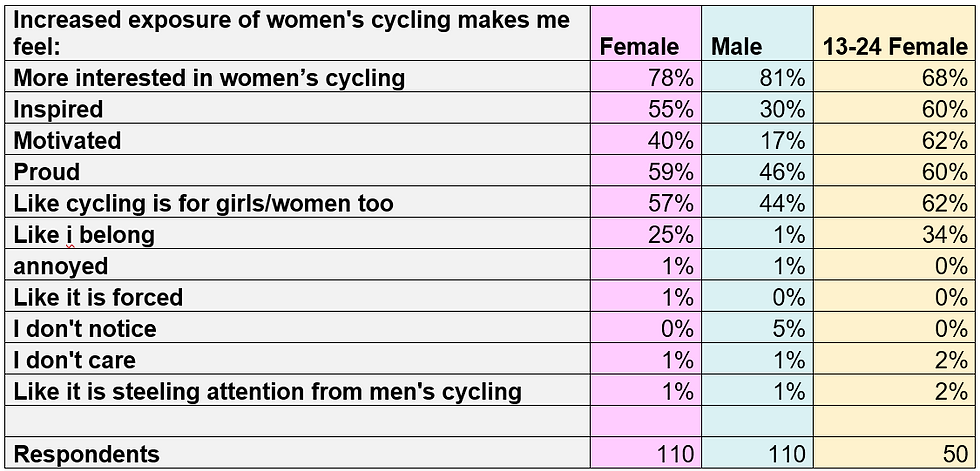
Additionally, when exposure of women's cycling increases it also creates positive feelings amongst both males and females, but they are especially strong amonst girls and young women.
Pathway into the sport
The visibility of women in cycling does not only affect whether girls and young women feel that they belong in the sport or whether they can imagine a future within it. It can also influence how they are introduced to cycling in the first place.
Looking at the 224 respondents' answers to the question “What inspired you to get into cycling?” (as a fan and/or as a rider), there are clear differences between male and female respondents.
28.7% of boys and men got introduced to the sport through the Tour de France while the same only goes for 10.7% of girls and women. A possible explanation for this is that boys have had more opportunities to identify with the riders they see in the Tour de France. On the other hand girls have historically had fewer visible female role models and less exposure to women's cycling.
Instead, many girls and women were introduced to cycling through family and friends. One 16–18-year-old respondent wrote:
"I went cycling when my older sister became the world champion on the track in 2016. It inspired me a lot, and I wanted to have the same good future as my sister. She left the sport after the Olympics, and I continue her path."
Another respondent, aged 19–24, answered:
"16 years ago, my brother won a very big medal.".
This suggests that family and friends may play a particularly important role in introducing girls and women to cycling, especially when there are fewer visible female role models to look up to. More visible women’s racing, such as the Tour de France Femmes, could therefore create another pathway into the sport and encourage more girls and women to become involved in cycling.
The prestige gap
Another aspect is the difference in how prestigious the two are perceived to be. Looking at the answers from all respondents, 90.5% associated men's cycling with more prestige than women's cycling. Only 3.2% felt that women's cycling has more prestige, while another 3.2% felt that the two have the same level of prestige.

But what does this difference in prestige actually mean?
This difference sparked negative emotions among many respondents, especially girls and women, but also boys and men. They described feelings of unfairness, frustration, sadness, and irritation.
One example is a 19–24-year-old woman who answered:
“Bad and sometimes unmotivated“
For others, it was more about the different opportunities men and women have in cycling. An example is a 13-15 year old girl who answered:
“I feel like it is unfair because women don’t get the same chances because there is less coverage (as in less sponsors etc.) “
And another 16–18-year-old respondent answered:
“Girls have to try twice as hard to get to where the boys get.”
This shows that when girls and women experience women's cycling as being associated with less prestige and fewer opportunities, it can affect their motivation and how they see themselves and their opportunities in the sport. However, not all women and girls associated lower prestige with negative feelings. One 19–24-year-old woman answered:
“I’m still proud being a women cyclist”
On the other hand one of the few who pointed to more prestige in women's cycling is a 16-18 year old girl who answered that it makes her feel:
”Confident, because women cycling becomes more and more popular from year to year”
This shows that when women's cycling is seen as more prestigious and valued, it can create positive feelings and make girls and women feel more confident about their place in the sport.
Can the Tour de France Femmes help close the gap - and what are the limits?

The Tour de France Femmes is already the biggest race in women's cycling, and its growing popularity shows that there is an audience for women's racing. Increased interest can make women's cycling more attractive to sponsors and media, bringing more investment and coverage to the sport. At the same time, increased coverage can help attract more fans and create even more interest, making the sport even more attractive to sponsors and media.
But how can the Tour de France Femmes avec Zwift help increase exposure of women's cycling?
More live coverage
One way to increase this exposure is through more live coverage. In the survey, increased TV coverage was one of the most common suggestions for improving the coverage of women's sport. For example:

“Full coverage from km 0 of more women’s cycling races.”
”They should show more parts of the race, not only the last hour.”
More stages being shown from start to finish would give viewers more opportunities to follow the race, get invested in the racing and get to know the riders, rather than only seeing the final 2.5 hours of most stages.
More accessibility
Even if the race is available internationally, it does not help much if people cannot easily watch it. This was also reflected in the survey, where greater accessibility was highlighted as an important way to improve the coverage of women’s cycling. One respondent suggested:
“More mainstream TV channels willing to broadcast it.”
Making the race available on more free-to-air and mainstream channels could give more girls and young women access to female riders they can relate to and look up to.
Broader international reach
The Tour de France Femmes could also increase exposure by bringing the race to more countries. International Grand Départs and other events could introduce women's cycling to new audiences and give more girls and women the opportunity to see female cyclists in their own country. One example is the 2027 Grand Départ in Yorkshire, where Sam Edward from Otley Cycling Club believes that the race and the crowds it attracts could provide:
“A huge boost to women and girls looking to start cycling”
International starts and events can therefore help introduce women's cycling and its role models to new audiences and potentially inspire more girls and women to get into the sport. However, this also depends on cities being interested in hosting the race and having the financial resources to do so
Longer Grand Tours?
Another suggestion from the survey was to make the Tour de France Femmes longer. A longer race would create more stages and more opportunities for people to follow the riders, get to know them and become invested in the race. And despite the physiological differences between men’s and women’s racing, some riders believe that a longer Tour de France Femmes could be possible in the future. As former proffesional and Olympic time trial champion Grace Brown put it:
“I think it's great to have a vision of the Tour de France Femmes avec Zwift of eventually being a two-week tour.”
However, some riders are also sceptical about making Grand Tours longer. In addition, a longer race would require more financial resources and enough interest from broadcasters, sponsors and fans to make it viable. Women's teams also generally have smaller rosters than men's teams, which makes it more difficult to make Grand Tours significantly longer without putting additional pressure on riders.
There is also no guarantee that simply adding more stages would lead to greater interest in women's cycling. As one survey respondent put it:
“There is nothing you can do to make people equally as interested in women's cycling because women do ride slower and shorter.”
This highlights that making the race longer could create more opportunities for exposure, but it cannot by itself guarantee that more people will watch or become interested in women's cycling.

Other limitations
Financial ressources
Increasing the size and reach of the race also requires money. More stages and greater coverage all come with additional costs. At the same time, financial resources and interest are closely connected. More interest can make the race more attractive to sponsors and broadcasters, while financial investment can help the race reach a larger audience and create more interest.
Media and external factors
TDFF also cannot fully control how much attention the race receives outside its own channels. The broadcasters decide how much of the race they want to show, while news outlets and other media decide how much they want to cover it.
This was also reflected in the survey, where respondents pointed to greater media attention as a way to improve the coverage of women's cycling. One respondent put it:
“It starts with the Media - some big media outlets seem to ignore the fact that women ride bikes totally.”
However, media attention is also closely connected to audience interest, as greater interest makes it more attractive for broadcasters and media outlets to cover the race. Kate Veronneau, Zwift’s Director of Women’s Strategy, highlights the importance of viewership for the future of the race:
“The key to success for this race is viewership. If people don’t tune in and therefore don’t turn up, it’s hard to make a case for continuing it.”
This shows how closely the future development of TDFF is connected to whether people actually watch and engage with the race. This means that while TDFF can work to increase its visibility, it cannot fully control how much attention it receives from external media or how much interest there is in the race.
All in all, the Tour de France Femmes has the potential to create a positive spiral where increased exposure leads to more interest, which can attract more media coverage, sponsors and investment. This can create even more exposure and make more female riders visible to girls and young women across different countries.
This matters because, as the survey suggests, seeing women’s cycling can have a positive effect on girls’ and young women’s motivation, confidence, sense of belonging and ability to imagine themselves in the sport. Increasing exposure could therefore not only help women’s cycling grow, but also give more girls and young women the opportunity to see someone like themselves at the highest level of the sport, and to imagine that they could be there too.

About the project: Methodology and limitations
I worked on this project in my final year of HHX, a Danish business and economics-focused upper secondary school (equivalent to high school). The project focused on the visibility gap between men's and women's cycling, with a focus on TDF and TDFF from 2022-2025 and what this difference can mean for girls and young women.
A central part of the project is a survey with 224 respondents, consisting of 112 female and 112 male respondents. The survey was shared through social media channels aimed at people interested in cycling or involved in the sport themselves. 52 of the respondents were girls and women aged 13–24, which is the main group I focus on in the project, and the ones who are in the category mentioned as girls and young women.
The survey is not statistically representative of the general population, or even of all cycling fans. Instead, it provides an indication of patterns and differences among people who are already interested in the sport. The answers are also self-reported, meaning that respondents may interpret questions differently, and their answers can be influenced by their own experiences or by what they believe is the “right” answer.
Demographics:



Kommentarer